

A Recent Review by Prairie Habitat Joint Venture Conservation Partners
Crop and livestock production provide food necessary for people, however some farming practices can be devastating for natural ecosystems. The conversion of wetlands to agricultural landscapes has cascading impacts on wildlife and the ecological services those habitats provide, such as flood mitigation, maintaining water quality and supporting recreational activities like hunting or birding. But, what do we know about farmers’ perceptions of the balancing act between wetland retention and agricultural productivity? Reporting on these perspectives is important, as understanding the motivations, thoughts and feelings of farmers helps conservation practitioners develop ways to help mitigate wetland loss while also supporting agricultural livelihoods.
Researchers at the University of Alberta — partners of the Prairie Habitat Joint Venture (PHJV) and members of our Human Dimensions Committee — used a global systemic mapping approach to delve into the current literature available on what farmers think, feel and do about wetlands.
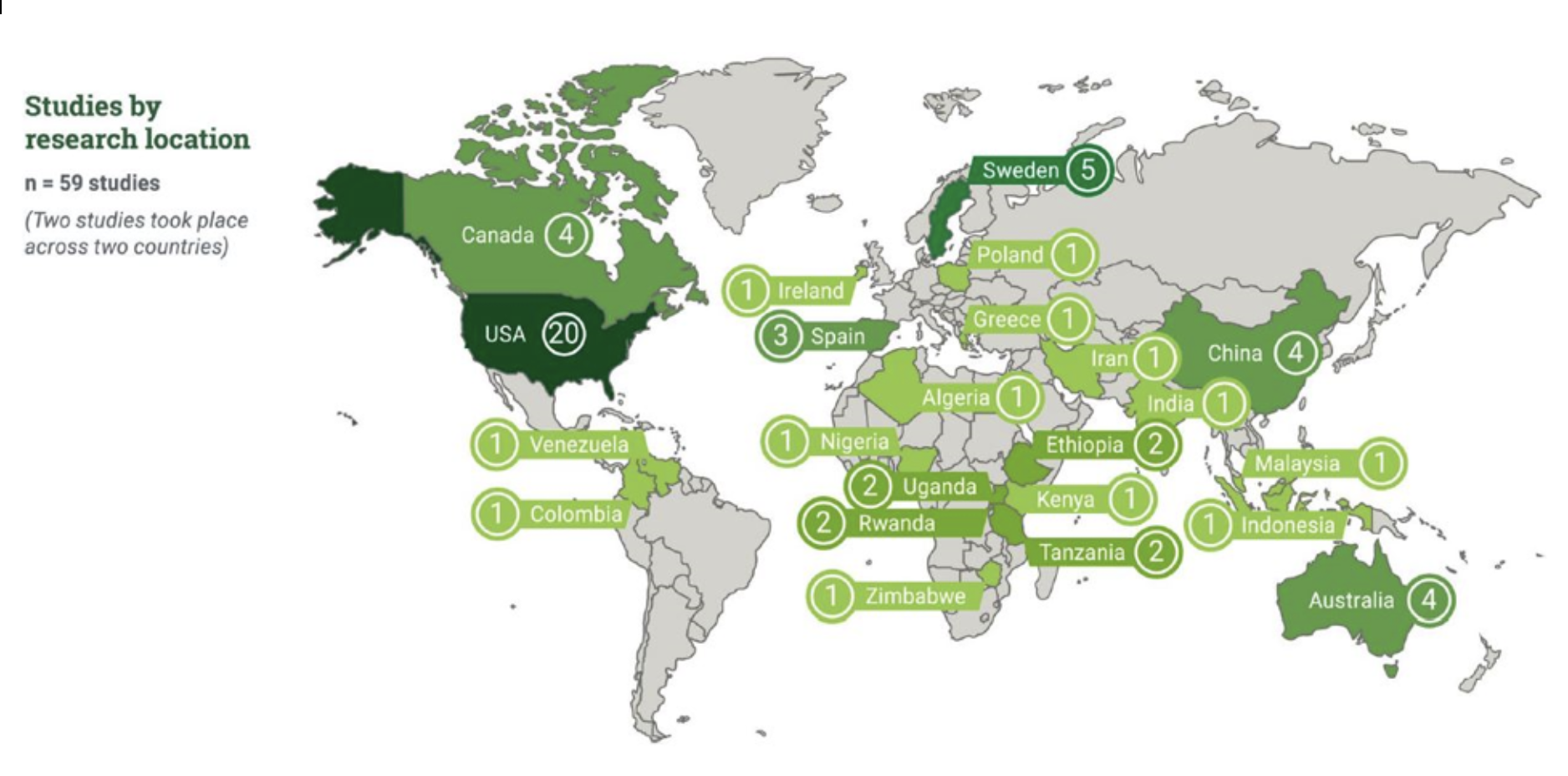
Figure 1. Number of social science studies about wetlands and farmers presented by research location. Sainsbury et al. 2026; shared with permission. Artwork created by Fuse Consulting Ltd.
The results of this large-scale review revealed some important insights:
- Only 59 studies over 50 years of research investigated farmer thoughts, feelings and behaviours regarding wetlands, making it difficult to apply specific farmer perspectives to conservation goals.
- Studies are global and growing: over 50 years, the rate has increased from 0.2 studies per year in the 1970s to 3.7 between 2020 and 2022 annually.
- Much of the literature focuses on crop production, which reflects an increased risk of drainage on cropped landscapes as compared to other activities, such as grazing. Knowledge about livestock producer perspectives is lacking.
- Constructed wetlands are becoming a popular approach to water management. Further studies on farmer perceptions of this wetland type are needed to understand how they’re viewed in farming contexts.
- There is a need for more qualitative (rather than quantitative) studies on farmer perceptions to inform wetland conservation programs.
- Farmer perceptions aren’t being reported in ways that can effectively help the conservation community. Much of their real-world knowledge and experience isn’t making its way to published research.
- There is a lack of studies involving program evaluations that delve into the social-environmental dynamics experienced by farmers, as well as behavioural change – a surprising finding given the large-scale funding of conservation programs.
This review provided an important look at the current available information on farmer perceptions on wetland conservation. Greater collaboration between farmers and social scientists is needed, as well as clear reporting so that findings are accessible, peer-reviewed and provide insights that are useful beyond an individual study.
This publication provides detailed insights into social science methodologies as well as in-depth assessments of the state of farmer perceptions in current research. Please see the original publication for the full story.
The study was recently presented as part of the PHJV Policy Committee Webinar Series, and you can watch the recording.
This work was supported by Wildlife Habitat Canada, Ducks Unlimited Canada, the Canadian Wetlands Roundtable, the Prairie Habitat Joint Venture, and the Alberta-NAWMP Partnership.
Sainsbury, K.A., Goodine, J.L., Harshaw, H.W. et al. How Much do we Know About What Farmers Think About Wetlands? A Global Systematic Map of Producer Perspectives. Wetlands 46, 89 (2026). doi.org/10.1007/s13157-026-02095-y
Contact Dr. Howie Harshaw harshaw@ualberta.ca to obtain a copy of the publication.
Banner photo credit: Ducks Unlimited Canada