

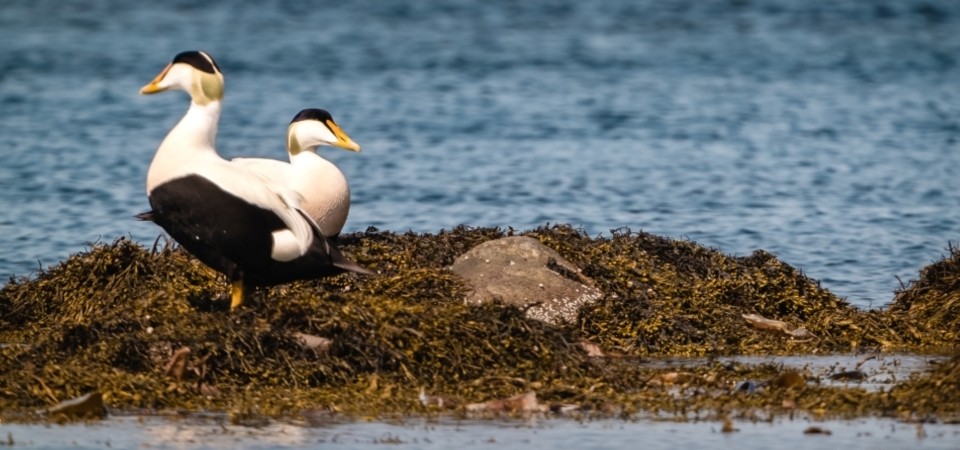
Since 2021, the Sea Duck Joint Venture has supported a large-scale collaborative research project to deploy Argos satellite tracking devices on American Common Eiders (Somateria mollissima dresseri). Eider populations have been declining across the southern part of their breeding range since the early 21st century. These changes are hypothesized to be caused by the rapid warming of ocean waters, which affects the distribution and quality of prey species. Additional possible causes include expanding fisheries and offshore energy development.
Between 2021 and 2024, a research team including federal, state, provincial, academic, and non-profit partners deployed 235 satellite transmitters in adult female eiders across their breeding range. 18 organizations worked together to catch birds in major breeding areas and embed transmitters, including locations in Maine, New Brunswick, Nova Scotia, Newfoundland, Labrador, and Québec. This real-time, continuous location data will improve scientific understanding of eider breeding propensity and population connectivity, and help managers identify key habitats for the species.
This is the largest active wildlife satellite tracking program in Canada — and among the top five in the world — based on the number of individuals transmitting information per month! The transmitters have collected 415,550 eider locations and tracked 1.4 million kilometers of movement as of September 27, 2025. Ultimately, this data will not only provide insight into eider population dynamics, but also help to mitigate the impact of human activities by informing harvest limits and regulations, marine planning, and restoration and protection efforts.
Read more on the Sea Duck Joint Venture website >>
Photo by Emile David